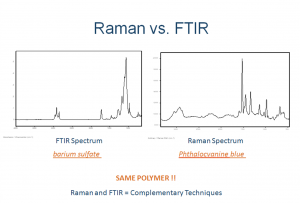
Comparison of Raman and FTIR Spectroscopy: Advantages and Limitations
Comparative Structural Analysis: Raman and FTIR Spectroscopy Synergy and Selection Logic
You’re standing in a high-end lab, staring at two expensive boxes that both claim to tell you exactly what’s inside your sample. One is a Raman spectrometer, and the other is a Fourier Transform Infrared (FTIR) bench. If you’re asking yourself, is Raman similar to FTIR, you aren’t alone; even seasoned researchers sometimes conflate the two because they both deal with molecular vibrations. But treating them as identical is a fast track to garbage data and wasted grant money.
Look—on the surface, they seem like siblings. They both produce a “fingerprint” spectrum that maps out how molecules wiggle, stretch, and bend. You get peaks, you get baselines, and you get a headache trying to interpret overlapping signals. Honestly, it’s easy to see why the question of whether is Raman similar to FTIR pops up so frequently in undergraduate labs and industrial QC departments alike.
It’s a big deal. Despite their similarities, the physics driving these two techniques are fundamentally different. While FTIR relies on the absorption of light, Raman is all about the scattering of light. This isn’t just a pedantic academic distinction. It changes everything from what containers you can use to whether a drop of water will completely ruin your afternoon.
Seriously, understanding the nuances between these two is the difference between an expert and a button-pusher. We’re going to dive into why they are complementary rather than redundant. It turns out that what one technique misses, the other usually catches with ease. It’s a tag-team approach to molecular spectroscopy.
Understanding the Vibrational Core and Molecular Fingerprints
Dipole Moments versus Polarizability Changes
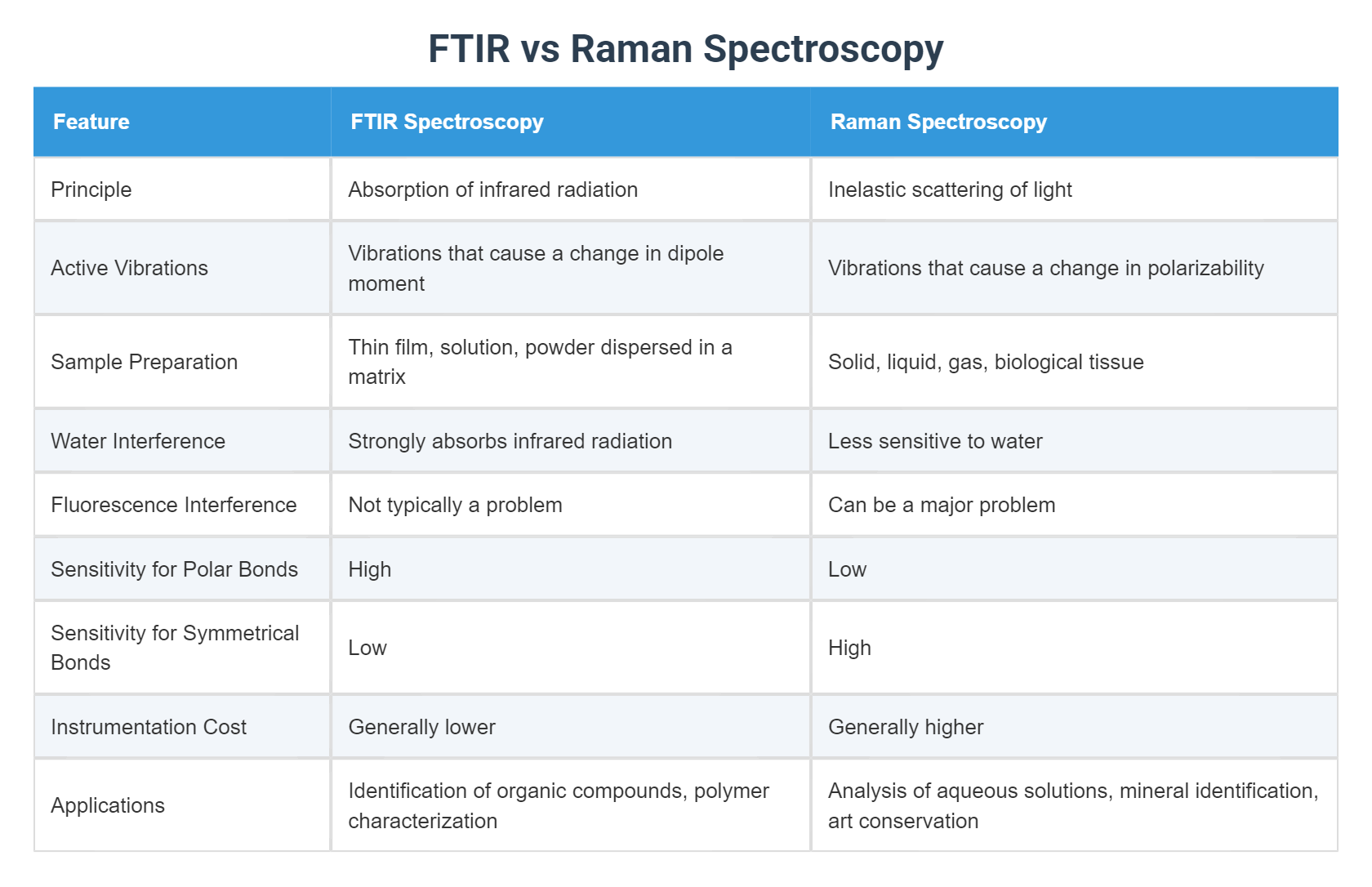
To really get if is Raman similar to FTIR, you have to look at the “selection rules” of physics. FTIR is a “greedy” technique; it looks for molecules that have a change in their dipole moment. When infrared light hits a molecule, if that molecule’s vibration changes its electrical asymmetry, the light gets absorbed. This makes FTIR incredibly sensitive to polar functional groups like carbonyls (C=O) or hydroxyls (O-H).
Raman spectroscopy, on the other hand, is much more “chill” about dipoles. It cares about polarizability—how easily the electron cloud of a molecule can be distorted. When you blast a sample with a laser, the photons bounce off, and a tiny fraction of them lose or gain energy based on these electron cloud shifts. This makes Raman spectroscopy vs FTIR a comparison of electrical asymmetry versus electron flexibility.

Differences between FTIR and Raman spectroscopy – analyzetest.com
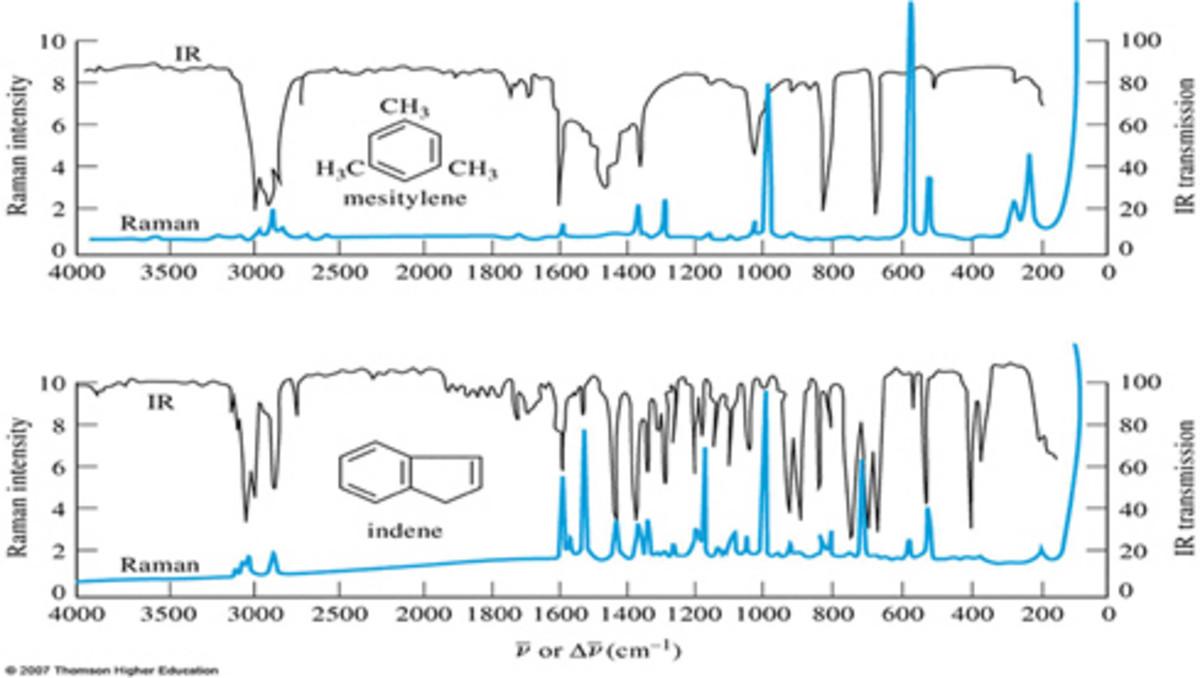
Because of this, is Raman similar to FTIR in terms of what they “see”? Not exactly. They often see the opposite sides of the same coin. A strong signal in FTIR might be a tiny blip in Raman, and a massive Raman peak might be completely invisible in the IR. It’s like one is listening for the bass and the other is listening for the treble; you need both to hear the full song.
I’ve spent years watching people try to force a Raman system to see a weak dipole change. It’s a fool’s errand. Stick to the physics. If your molecule is highly symmetric, Raman is going to be your best friend. If it’s loaded with oxygen and hydrogen in lopsided bonds, stick with the FTIR bench.
Symmetry Rules in Molecular Identification
There is a concept in spectroscopy called the Rule of Mutual Exclusion. For molecules with a center of symmetry, a vibration that is active in the IR will be inactive in the Raman, and vice versa. This is the ultimate proof that while is Raman similar to FTIR in objective, they are distinct in execution. They literally cannot do each other’s jobs in these specific cases.
This symmetry rule is why vibrational spectroscopy is such a powerhouse in structural chemistry. By comparing the two spectra, you can determine if a molecule is centrosymmetric. If you see a peak at 1600 cm-1 in your Raman plot but nothing in your FTIR at that same spot, you’ve just learned something profound about the geometry of your sample. It’s high-level detective work.
Most real-world samples aren’t perfectly symmetric, so you’ll often see peaks in both. But the intensities will be wildly different. Raman loves carbon-carbon double bonds and aromatic rings. FTIR loves those pesky, highly polar bonds. Knowing this allows you to pick your weapon based on the chemistry you’re hunting.
It works.
Practical Hurdles and the Quest for Data Accuracy
Navigating Fluorescence and Thermal Interference
Ftir Spectroscopy Vs Raman at Richard Travis blog
If you want to know is Raman similar to FTIR when things go wrong, the answer is a resounding no. Raman has a mortal enemy: fluorescence. You try to scan a natural product or a dyed polymer, and suddenly your screen is just a giant, sloping hill of noise. The laser excites the sample so much that it glows, drowning out the weak Raman scattering. It’s frustrating as hell.
FTIR doesn’t have a fluorescence problem. Since it’s an absorption technique using lower-energy mid-infrared light, it doesn’t typically kick electrons into excited states that lead to glowing. However, FTIR has its own demons, primarily water. Water is a massive IR absorber. If your sample is wet, the O-H stretch from the water will swallow your signal whole, leaving you with nothing but a broad, useless blob.
This creates a clear divide in the comparison of Raman and FTIR. Working with aqueous solutions? Raman is your king because water is a very weak Raman scatterer. Working with something that fluoresces like crazy? Move over to the FTIR. This is why most professional labs keep both instruments within walking distance of each other.
Honestly? Fluorescence has ruined more of my Friday afternoons than I care to admit. You can try changing the laser wavelength (moving to 785nm or 1064nm), but sometimes, the chemistry just says “no.” That’s when you appreciate the steady, reliable nature of an FTIR spectrometer.
Sample Preparation and Throughput Efficiency
Sample prep is where these two really diverge. Is Raman similar to FTIR in terms of ease of use? Generally, Raman wins the “laziness” trophy. With Raman, you can often point the laser through a glass vial or a plastic bag and get a signal. No contact, no mess, no grinding things into KBr pellets. It’s the ultimate “point and shoot” tool for the modern analyst.
FTIR has improved with Attenuated Total Reflection (ATR) crystals, which let you just smash a sample onto a diamond, but it still requires direct contact. You have to clean the crystal between every single run. If you’re dealing with something toxic or air-sensitive, the non-contact nature of Raman analysis is a literal life-saver. You keep the nasty stuff sealed in a glass jar and scan right through the wall.
That said, FTIR is often more “quantifiable” for beginners. The relationship between concentration and absorbance (Beer-Lambert Law) is straightforward in IR. In Raman, factors like laser power, focus, and sample color make quantification a bit of a nightmare for the uninitiated. You need internal standards and a lot of patience to get real numbers out of a Raman rig.

Ftir And Raman Differences | Raman Vs Ftir – TWYPA
- Check for fluorescence; if high, use FTIR.
- Check for water content; if high, use Raman.
- Check for symmetry; use both if possible.
- Assess container needs; Raman for glass/plastic.
Determining the Right Analytical Pathway
Strategic Selection for Aqueous Solutions
When someone asks is Raman similar to FTIR for biological samples, I always point them toward Raman. Since biology is mostly water, and water is “transparent” to Raman, you can look at live cells, proteins in buffer, or even the inside of a juice box without much trouble. Trying to do that with FTIR requires incredibly thin paths or specialized (and expensive) flow cells that clog if you look at them wrong.
Raman is also fantastic for polymorphic identification in pharmaceuticals. Because it’s sensitive to the crystal lattice vibrations, it can tell the difference between two different shapes of the same drug molecule. FTIR can do this too, but the differences are often much more subtle in the IR region. Raman peaks for lattice modes are usually sharp and distinct.

Difference Between FTIR and Raman Spectroscopy | Compare the Difference …
Think about that for a second. You could be monitoring a chemical reaction in a pressurized glass reactor in real-time. A Raman probe goes right against the glass. You see the bonds forming and breaking without ever opening the vessel. That is the power of choosing the right spectroscopic method for the environment.
It’s a total game changer for process analytical technology (PAT). In the pharma and oil industries, Raman probes are shoved into pipes and tanks everywhere. FTIR is much harder to implement in those “in-the-wild” scenarios because of the optical fiber limitations and the moisture issues. Raman just handles it better.
Enhancing Signal with Complementary Datasets
The best labs don’t pick one; they use both. When you combine Raman and FTIR data, you get a holistic view of the molecular structure. This is often called “orthogonal testing.” If both techniques confirm the presence of a specific functional group, your confidence in the result skyrockets. If they disagree, you know you have a complex mixture or a symmetry-related anomaly to investigate.
We also have to talk about the “fingerprint region.” Below 1500 cm-1, the spectra get incredibly crowded with complex bending and stretching modes. This is where the similarities between Raman and FTIR are most apparent, yet the patterns are unique. Often, a tiny shift in a Raman peak in this region can tell you about the stress or strain on a polymer chain that FTIR might miss entirely.
Usage of both tools is standard practice in forensics and art conservation. If you’re trying to identify the pigment in a 500-year-old painting, you use Raman for the inorganic pigments (like ultramarine or ochre) because it excels at low-frequency vibrations. Then you use FTIR to identify the organic binder (like egg yolk or linseed oil) because it’s much better at identifying those complex organic fats and proteins.
-
- Raman Spectroscopy: Best for non-polar bonds, inorganic materials, and aqueous solutions.
- FTIR Spectroscopy: Best for polar bonds, organic polymers, and samples prone to fluorescence.
FTIR vs Raman Spectroscopy
- Combined Approach: Essential for unknown identification and high-stakes structural verification.
Common Questions About Is Raman Similar To Ftir
Can I use Raman instead of FTIR for all my samples?
No, you definitely can’t. While Raman is versatile, many organic compounds will fluoresce under a laser, making the data unusable. Furthermore, some functional groups that are very strong in FTIR are very weak in Raman. You’ll miss critical information if you only rely on one.
Is Raman more expensive than FTIR?
Generally, yes. While prices are coming down, a high-quality Raman spectrometer usually costs more than a standard FTIR-ATR bench. The lasers and high-end detectors (CCDs) required for Raman are precision components that carry a premium price tag compared to the relatively simple IR sources and interferometers in an FTIR.
Do I need a PhD to interpret Raman and FTIR spectra?
Not necessarily, but it helps to have a solid grasp of organic chemistry. Most modern software comes with extensive libraries where the computer compares your “unknown” to thousands of known standards. However, the computer can be wrong, so having a human expert verify the peaks is always the safest bet.
Which technique is faster for routine testing?
FTIR-ATR is usually faster for a single, dry sample because the data acquisition takes seconds. Raman can be just as fast, but if you have to deal with fluorescence or need to average many scans to see a weak signal, it can take several minutes per sample. For “point and shoot” through glass, Raman is the undisputed speed king.
The truth is that is Raman similar to FTIR is a question that reveals the beautiful complexity of light interacting with matter. They are the two halves of a whole. One sees what the other ignores, and together, they provide the most complete picture of the molecular world we have ever had.