
Conceptual difference between EKF and UKF | Download Scientific Diagram
Non-linear System Precision: The Unscented Kalman Filter Advantage
I remember the first time I saw a high-end autonomous drone flip itself into a concrete wall because the navigation filter thought — quite confidently — that “up” was actually “sideways.” It was a classic failure of the Extended Kalman Filter (EKF) trying to handle a maneuver that was just too aggressive for its math. The EKF is the old reliable workhorse of the industry, but when things get weird and non-linear, it tends to lose its mind. This is exactly why UKF is often better than EKF for non-linear systems.
Look, the Kalman Filter is essentially an accountant for uncertainty. It tries to guess where a system is while acknowledging that its sensors are noisy and its models are imperfect. The EKF does this by pretending everything is linear for a split second, using a bit of calculus called a Jacobian. But here's the rub: if the system is changing fast or the curve is too sharp, that linear approximation is essentially a lie. And in engineering, lies lead to broken hardware.
The Unscented Kalman Filter (UKF) doesn't try to linearize the function. Instead, it uses a deterministic sampling technique. It picks a few choice points, shoves them through the actual, messy, non-linear equations, and sees where they land. It's a brute-force approach that is, ironically, much more elegant and accurate than the sophisticated “shortcuts” the EKF takes.
Honestly? If you are still manually deriving Jacobians in 2025, you are either a glutton for punishment or you haven't seen a UKF in action. It's a big deal. Once you make the switch, you rarely find a reason to go back to the Taylor series approximations of the past.
The Fundamental Failure of First-Order Linearization
The EKF relies on a first-order Taylor series expansion to approximate non-linear functions. Imagine trying to describe the shape of a roller coaster using only straight sticks; if the coaster has a tight loop, your straight sticks are going to point into empty space. That is precisely what happens to the mean and covariance in an EKF when the system model is highly curved. It's a mathematical compromise that was necessary back when computing power was a scarce resource.
Seriously, the error introduced by this approximation isn't just a minor annoyance. It is a systematic bias. Because the EKF only looks at the first derivative, it ignores the “spread” of the probability distribution as it passes through the non-linear function. This leads to an inconsistent filter that thinks it is much more accurate than it actually is. When a filter becomes overconfident and wrong, it ignores new sensor data, and that is when your system diverges.
We see this constantly in satellite tracking and long-range ballistic estimation. The further a point moves along a non-linear trajectory, the more the EKF's “best guess” drifts from the true physical location. Why UKF is often better than EKF for non-linear systems is fundamentally about its ability to maintain the integrity of the probability distribution. It doesn't just guess the center; it respects the shape of the uncertainty.
It is a bit like trying to navigate a forest with a map from the 1800s. It might get you through the clearing, but once you hit the dense brush, the landmarks don't line up anymore. The EKF is that old map. The UKF, by contrast, is like having a GPS that updates based on the terrain you are actually standing on right now.
The Hidden Costs of Jacobian Calculations

Comparison of EKF and UKF for Target A-Part 1 | Download Scientific Diagram
One of the most annoying aspects of the EKF is the requirement to calculate the Jacobian matrix. If you have a complex system with dozens of states, deriving these partial derivatives by hand is a recipe for disaster. One tiny sign error in a matrix of forty elements will ruin your entire week. I've seen teams spend months debugging “filter instability” only to find a single misplaced “cos(theta)” in their Jacobian code.
The UKF completely sidesteps this mess. Because it is “derivative-free,” you don't need to differentiate anything. You just provide the raw non-linear function. This makes the UKF much easier to implement and maintain. In a production environment, code that is easier to read and harder to break is always the superior choice.
Furthermore, some functions aren't even differentiable. If your model includes “if-then” logic, lookup tables, or discrete jumps, the EKF just gives up. The UKF doesn't care. It treats the function as a black box. You put points in, and you get points out. It is robust in ways the EKF could never dream of being.
Think about the time saved. No more symbolic math toolboxes, no more complex chain-rule derivations, and no more debugging math that was written on a whiteboard three months ago. You just write the physics, and the UKF handles the statistics. It's a massive workflow improvement.
Taylor Series Truncation and State Drift
The EKF discards higher-order terms of the Taylor series, specifically everything from the second order onwards. In a perfectly linear world, this doesn't matter. But in the real world — where things rotate, accelerate, and move in three dimensions — those discarded terms represent real physical reality. By throwing them away, the EKF introduces a “linearization error” that accumulates over time.
This accumulation is known as state drift. In a robot navigating a room, this might mean it thinks it is two inches to the left of where it actually is. In an autonomous vehicle driving at highway speeds, that drift can be the difference between staying in the lane and hitting a guardrail. The EKF is essentially guessing the future based on a simplified version of the present.
The UKF is often described as being accurate to “at least the second order” and often the third order for Gaussian inputs. This isn't just academic jargon; it means the UKF captures the curvature of the transformation. It understands that when a distribution goes through a curve, the mean shifts and the shape deforms. Why UKF is often better than EKF for non-linear systems is rooted in this higher-order accuracy.
Look — the math doesn't lie. If you compare the EKF and UKF on a standard benchmark like a highly non-linear radar tracking problem, the UKF will almost always show a smaller Mean Squared Error. It tracks the “true” state more closely because it isn't ignoring the very things that make the system non-linear in the first place.
Algorithmic Superiority through the Unscented Transform
At the heart of the UKF is the Unscented Transform. The name sounds like something out of a spa menu, but it's actually a brilliant bit of statistical engineering. Instead of trying to transform an entire probability density function (which is impossible) or linearizing the function (which is inaccurate), the UKF picks a minimal set of sample points called “sigma points.” These points are carefully chosen to represent the mean and covariance of the current state.

Illustration of EKF and UKF. | Download Scientific Diagram
These sigma points are then propagated through the actual non-linear equation. We aren't approximating the function; we are using the real deal. After the points are moved, we calculate their new mean and covariance. Because we used the actual non-linear function, the resulting distribution is a much more faithful representation of reality. It's a “sampling-based” approach that is far more efficient than a Monte Carlo simulation.
This is where the magic happens. The UKF captures the way the distribution “spreads” or “squeezes” as it moves. If you've ever seen a visual comparison of how an EKF and UKF handle a polar-to-Cartesian transformation, the difference is staggering. The EKF stays as a perfect, misplaced ellipse, while the UKF correctly identifies the “banana-shaped” distribution that actually occurs.
Honestly? It feels like cheating. You get the accuracy of complex numerical methods with the speed of a Kalman filter. It's the best of both worlds. For anyone working in robotics or aerospace, the Unscented Transform is the “secret sauce” that makes modern precision possible.
Sigma Point Distribution Mastery
The selection of sigma points is not random. The UKF uses a specific algorithm to place these points around the mean, typically at the boundaries of the covariance “cloud.” Usually, for an $n$-dimensional system, you only need $2n+1$ points. If you have a 3D position and 3D velocity, that is only 13 points. That is a tiny amount of computation for a huge gain in accuracy.
These points are weighted. The center point carries more weight for the mean, while the peripheral points help define the covariance. By adjusting these weights, you can actually tune the filter to be more or less sensitive to the “spread” of your data. This level of control is simply non-existent in the standard EKF framework.
- Mean Preservation: Sigma points ensure the predicted mean doesn't shift incorrectly during the update.
- Covariance Scaling: The points capture how the uncertainty grows in specific directions.
- Deterministic Nature: Unlike particle filters, the UKF results are repeatable and don't rely on random numbers.
- Reduced Sensitivity: The UKF is generally more robust to poor initial estimates than the EKF.

1: Illustration of principle of EKF and UKF | Download Scientific Diagram
When you look at why UKF is often better than EKF for non-linear systems, the efficiency of these sigma points is a major factor. You aren't wasting cycles on thousands of random samples like a Particle Filter, but you aren't flying blind like an EKF. It is the “Goldilocks” zone of state estimation.
Preservation of Higher-Order Statistical Moments
Most filters assume everything is a Gaussian (a bell curve). While the UKF also works within a Gaussian framework, it is much better at preserving the “shape” of that bell curve through non-linearities. In an EKF, the non-linear function often “skews” the distribution, but the linear approximation can't see that skew. The UKF actually tracks how the distribution might become less symmetric.
This preservation of moments means the UKF handles “heavy-tailed” distributions or sensor noise that isn't perfectly clean much better than the EKF. In the real world, sensor noise is rarely a perfect Gaussian. It has spikes, it has bias, and it has weird offsets. The UKF's sampling approach naturally buffers against some of these irregularities.
Think of it as the difference between looking at a silhouette of a person (EKF) and looking at a 3D model (UKF). The silhouette might give you the general height and width, but it misses all the depth and detail. When the person turns sideways, the silhouette might disappear or change drastically. The 3D model remains accurate regardless of the angle.
In high-stakes environments — think autonomous surgical robots or self-landing rockets — those higher-order moments are the difference between a successful mission and a catastrophic failure. The UKF provides the mathematical “fidelity” that modern technology demands.
Real-World Implementation Benefits and Robustness
From a software engineering perspective, the UKF is a dream. In a traditional EKF, every time you change your sensor suite or your physical model, you have to re-derive your Jacobians. This makes the code brittle. If a junior dev changes a constant in the physics engine but forgets to update the Jacobian matrix, the filter will slowly (or quickly) die. The UKF eliminates this dependency entirely.
Moreover, the UKF is surprisingly computationally efficient. People often assume that because it runs the model multiple times (for each sigma point), it must be much slower than the EKF. But that isn't necessarily true. Calculating a complex Jacobian can actually be more “expensive” in terms of CPU cycles than running a simple non-linear function a dozen times. In many real-world tests, the UKF is nearly as fast as the EKF, if not faster in complex scenarios.
It is also much easier to tune. Because the UKF is more “honest” about its uncertainty, the covariance matrices usually behave better. You don't have to spend weeks “massaging” the process noise values just to keep the filter from exploding. It just… works. This robustness is a primary reason why UKF is often better than EKF for non-linear systems in industrial applications.

Comparison of EKF and UKF for Nonlinear Models
Look, I've been in the trenches of sensor fusion for a long time. The EKF has its place for very simple, low-power microcontrollers where every microsecond counts. But for anything running on a modern ARM processor or better? The UKF is the standard. It provides a level of peace of mind that you just can't get when you're relying on first-order approximations.
Handling Severe System Discontinuities
Real systems have limits. Actuators hit stops, sensors saturate, and logic switches between modes. These are discontinuities. If you try to take a derivative of a discontinuous function, you get a “mathematical scream” (usually an undefined value or an infinite gradient). The EKF hates this. It either crashes or produces a garbage output that ruins the state estimate.
The UKF handles these hurdles with ease. If one sigma point hits a sensor limit, it just moves to that limit. The mean and covariance then update based on the fact that some of the samples are now bunched up at the ceiling. The filter stays stable. This is critical for systems that operate near their physical limits, like high-performance jets or industrial CNC machines.
- Saturation: UKF handles sensor clipping without losing track of the state.
- Mode Switching: If a system changes behavior (e.g., a drone landing and switching to “ground mode”), the UKF adapts smoothly.
- Non-Smooth Physics: Friction models or impact models that aren't “smooth” don't break the filter.
- Logical Constraints: You can bake “if” statements directly into your prediction model.
This ability to handle “ugly” math is why the UKF is so beloved in the field. It doesn't require you to “clean up” your physics just to satisfy the requirements of a derivative. You can model the world as it actually is, warts and all, and the filter will keep up.
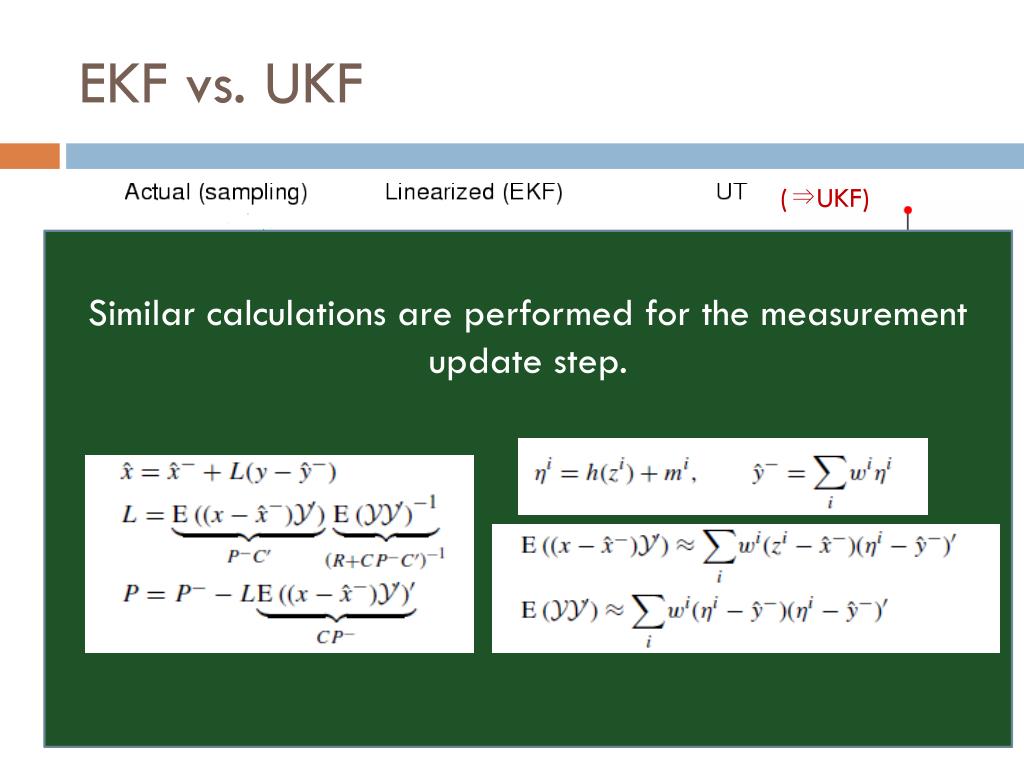
PPT – STOCHASTIC APPROACH To State Estimation Current Status and Open …
Coding Complexity and Maintenance Realities
Let's talk about the human factor. High-performance code is only useful if it can be maintained. When you use an EKF, the person who inherits your code needs to understand both the system physics and the specific calculus used to linearize it. If they don't have a strong math background, they are going to be terrified of touching that Jacobian function.
The UKF code is much more modular. You have a “filter” object and a “model” function. To change the system, you only change the model function. The filter logic stays exactly the same. This separation of concerns is a hallmark of good software design. It allows physicists to work on the model and software engineers to work on the filter without stepping on each other's toes.
Seriously, the maintenance cost of an EKF is a hidden tax on your project. Every time the requirements change, the EKF demands a tribute of mathematical derivation. The UKF just asks for the new equation. Over the lifecycle of a product, this saves hundreds of hours of senior engineering time.
It also makes unit testing significantly easier. You can test your non-linear model in isolation, and you can test the UKF framework with a simple linear model to verify it. Once both are solid, you just plug them together. It is a cleaner, faster, and more reliable way to build complex state estimation software.
Common Questions About Why UKF is often better than EKF for non-linear systems
Is the UKF always better than the EKF in every single situation?
Not necessarily. In systems that are very close to linear, the EKF is slightly faster and produces nearly identical results. If you are running on a tiny 8-bit microcontroller with no floating-point unit, the EKF might be your only option. However, for most modern applications, the UKF's accuracy outweighs the EKF's speed advantage.
Does the UKF require more memory than the EKF?
Slightly. Since the UKF needs to store and propagate multiple sigma points, it requires a bit more RAM to hold those intermediate states. However, for most systems, we are talking about a few kilobytes at most. In the context of modern hardware, this memory overhead is negligible and shouldn't be a deciding factor.
Can I use the UKF for real-time applications with high frequency?
Absolutely. Many flight controllers and self-driving car stacks use UKFs running at 100Hz or even 1000Hz. Unless your state vector is massive (hundreds of dimensions), a modern processor will have no trouble running the sigma point transformations in real-time. The computational “cost” is often exaggerated.
What happens if my system is extremely non-Gaussian?
While the UKF is better than the EKF for non-linearities, it still assumes the underlying noise is Gaussian. If your noise is wildly multi-modal (like having two distinct “most likely” positions), you might need to look at a Particle Filter. But for 95% of engineering problems, the UKF provides the best balance of performance and complexity.
In the end, the choice between filters comes down to how much you trust your linearizations. If you want a filter that is easier to write, harder to break, and consistently more accurate in the face of complex curves, the Unscented Kalman Filter is the clear winner. Stop struggling with Jacobians and let the sigma points do the heavy lifting for you.